
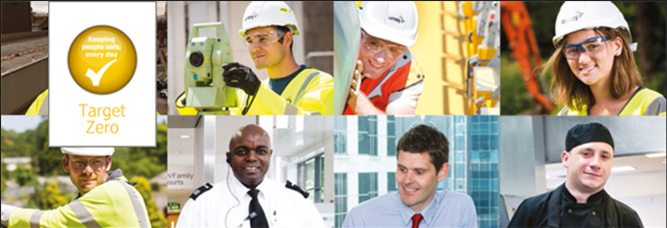
Target Zero
safety campaign
In 2016, Amey was a civil engineering and infrastructure services company with over 20,000 employees, around 70% of whom worked on the frontline in roles such as highways, rail and facilities management. Keeping people safe in that environment is both a legal and moral imperative, and a significant communications challenge.
I defined, planned and wrote the entire campaign, including video scripts, briefings and guides, built around the Keil Centre approach: making leaders, managers and employees aware of each other's responsibilities, so they hold each other accountable.
The campaign aimed to engage everyone consistently while allowing for localised messaging, and to support the corporate safety objective of keeping people safe, every day. Underpinning everything was a clear goal: to reduce harm by improving safety numbers across the business..
Results
Best safety statistics for 13 years. Winner, HR Excellence Award: Most Effective Use of Internal Communications.
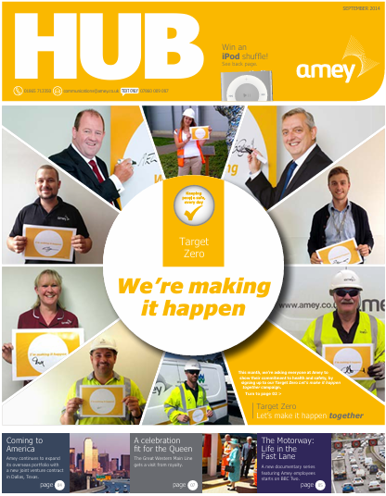
Phase one - launch
Each audience received a carefully tailored package. Leaders received a branded folder containing a guide, a launch video, printed materials on all topics, and a memory stick with all files and a catalogue of branded materials.
Managers received their own briefing pack with equivalent resources. For everyone else, their manager briefed them locally, supported by a feature in the company magazine and posters.
Each employee signed a pledge poster that was displayed in their area, and received a wallet card carrying key contact numbers, including the signatures of the CEO and Health & Safety Director.
Phase two - focus on empathy
I delivered the phase two kick-off at the internal health and safety conference, where I drew on a personal experience of work-related bereavement to demonstrate the power of genuine storytelling and encourage this approach in the manager cascade.
The Please Wake Up video followed, aimed at raising empathy and helping people understand how far the psychological impact of workplace harm reaches beyond the injured person
Phase three - embedding learning
The Don't Blame Me video used the same actors to continue the story from Please Wake Up, bringing continuity to the narrative while tackling the unfortunately common tendency to attribute fault to the person who was harmed, rather than examining every possible contributing factor, such as training gaps, stress or poor communication.
The script was written to ensure we showed viewpoints from every character. A root cause approach demonstrated that errors can happen at any level, demonstrating fairness and not jumping to blame the injured party.